
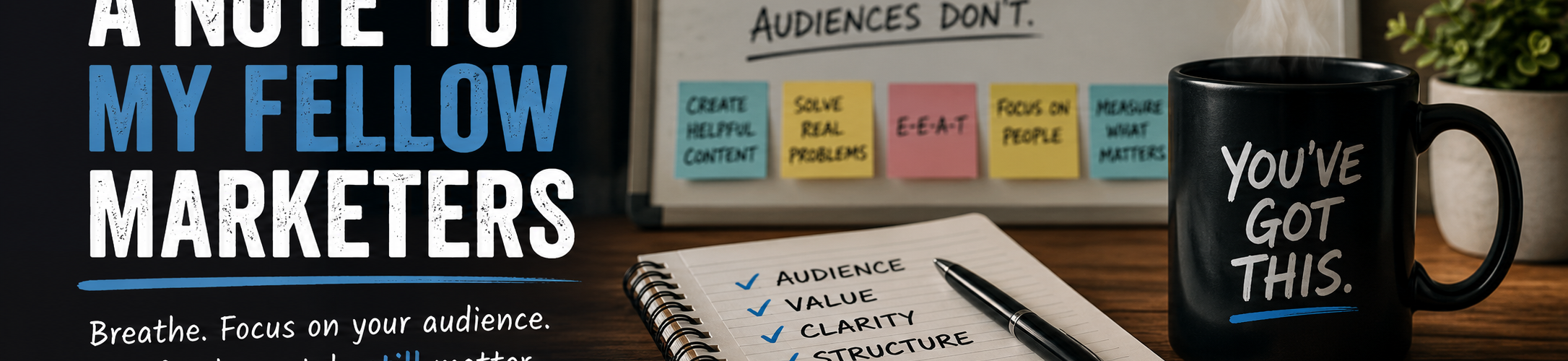
You’ve got this
Hi guys.
Checking in to see how everyone’s doing with the whole “Google is changing our lives and wreaking havoc on our understanding of reality for content and marketing” thing. How’s everyone holding up?
This is mainly for the marketing, SEO, and content folks who are unwinding the latest “innovations” and navigating the flood of reactions, hot takes, and “expertise” articles being published everywhere by people racing to be first to market and earn authority on the topic.
Then, of course, there are all the tool and solution companies telling you about their research and how everything you’ve been doing isn’t moving the needle. Combine that with the increasing cost of Happy Hours, and it’s been a rough couple of weeks. I know.
But I just want to dial you back in.
Give you a chance to breathe.
You’ve got this.
Google may have changed, but your audience hasn’t.
I’ve been doing this thing called marketing—heavily focused on content marketing—for more than 35 years. We’ve seen the pendulum swing. We’ve watched trends spin out of control. We’ve seen spectacular failures and some decent wins. But the foundations have always remained, and they always will.
You’ve got this.
Google hasn’t changed its foundations, so you shouldn’t either: E-E-A-T.
Write good content that supports your goals and objectives. Be clear. Be concise. Be direct. Be engaging.
Address your audience’s needs. Market your business.
What They’re Saying
Just to cover a few laughable specifics that companies and “experts” are pushing:
1. Structured content doesn’t move the needle
BS.
We’ve been fighting for structured content since the dawn of content marketing. We got an inch, and we’re NEVER giving it up.
Structured content matters. It matters in education, textbooks, novels, articles, SEO, GEO, and accessibility. It matters because it matters to your audience.
2. Chunky, scannable content doesn’t move the needle.
BS.
Most people don’t read entire articles. (Okay, fine, some do. But are they your audience?)
Give people what they’re looking for. Keep it short, simple, and easy to scan. Help them quickly find what matters to them and verify that it’s relevant.
3. Schema doesn’t matter.
BS.
You’re not adding schema for your audience. You’re adding schema for the bots and algorithms that may not recognize, understand, or prioritize your content.
Let’s be honest: AI scans content and misses things all the time.
Schema is essentially labeling content for automation. It’s a way of structuring information for machines. And whether we like it or not, AI is now another audience type.
4. FAQs and question-based formatting don’t matter.
Oh yeah? It matters.
Question-based content makes it easier for every audience—human or machine—to find quick answers, summaries, and relevant information.
5. Links Matter
Yeah, they really do. Always have.
Internal links, external links, backlinks—they’ve always mattered, and they always will.
At a foundational level, links help audiences verify what you’ve said and explore topics more deeply. They also signal to LLMs and AI agents that there’s additional information and expertise behind what they’re reading.
Backlinks, of course, are validation. They’re the Sally Field moment of the internet: “You like me. You really like me.” And if enough credible sources point back to you, that expertise becomes easier to trust.
Don’t Panic
So don’t give up on the foundational expertise you’ve been fighting for because some big company made a claim (and then others jumped on the bandwagon to support it as also rans) because you know marketing, you know content, you know your audience. Remember, AI doesn’t know who’s right. It knows who’s being cited, who’s being repeated, and who’s being agreed with. Those things overlap with expertise, but they aren’t the same thing.
Before we start treating every new claim as gospel, remember that half the articles being written about these changes are likely being generated from the same handful of original sources anyway. (Since we know content and marketing were the early hits for replacement with AI, and senior levels have to justify their decisions to do that!)
Let’s not forget, Agentic Search appears to reward signals of consensus. The challenge is that consensus and correctness isn’t necessarily the same thing. (Humans tend to fall back on that, too – social proof, peer pressure, authority bias, etc.)
- You know marketing.
- You know content.
- You know your audience.
There are always new players entering the marketing and content world who think they’ve discovered a better way. We’ve been dealing with that our entire careers. We’ve been told marketing isn’t a real department. That content isn’t a real skill. That what we do can be automated, outsourced, or ignored.
We know better.
We know what marketing is. We know how to wield content like Excalibur.
If anything, this new world is proving that marketing is becoming even more central to business success. That means this is our opportunity to gain as much ground as possible.
Let the “I’ve got a better idea” crowd run their experiments.
Meanwhile, we’ll focus on what our own data shows, what our own audiences need, and what actually helps us achieve our business goals and objectives.
Just like we always have.
So breathe.
You’ve got this.
But don’t you DARE give an inch on structured content.